
Home » Roofing » Roofing Company in Ferndale, MI
Ferndale is a bungalow town. The overwhelming majority of housing here went up between the early 1920s and the early 1940s, built fast and built small for workers streaming into the auto industry, on lots that are frequently forty feet wide. When homeowners look for a roofing company Ferndale MI can send out, they are almost always dealing with a hundred-year-old brick house on a lot with no driveway to work from.
Both halves of that matter. The houses share a specific set of roofing problems, and the lots make the work itself logistically different from anywhere else in Oakland County.
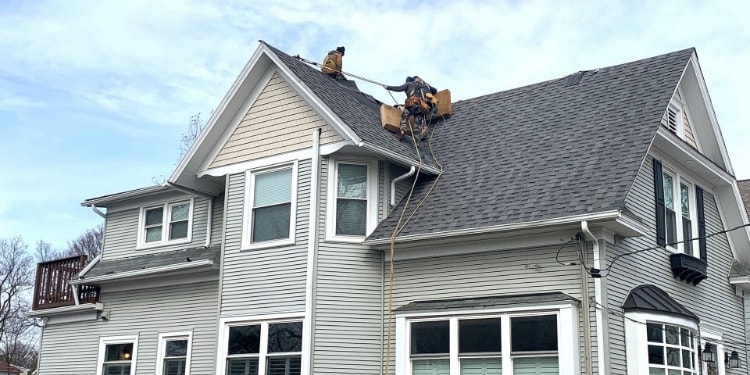
A century-old house has had three or four roofs. What is underneath matters more than what is on top. We routinely find original plank decking with gaps between boards, and occasionally remnants of the original wood shake still buried under later layers. Both affect how modern shingles fasten and whether the manufacturer will warrant the installation.
The Tudors add steeper pitches and more complicated geometry to the same underlying age problem.
Half the bungalows in Ferndale have had a dormer added at some point, because that is how you get a usable second floor out of a story-and-a-half house. Those dormers were added across a span of eighty years by contractors of wildly varying skill.
The dormer sidewall is the single most common leak source we find in this city. Step flashing has to be woven into the siding course by course. When a dormer was added quickly, that detail was often replaced with a bent strip and a bead of caulk, which fails within a few years and then gets caulked again by the next person.
Ferndale's desirability has driven a lot of full second-story additions over the past two decades. Where new roof meets original roof is a junction, and junctions leak when they were detailed by a framing crew rather than a roofing crew.
We look hard at these. An addition tie-in that was done properly is invisible. One that was not shows up as staining on an interior ceiling several feet away from the actual entry point.
These homes were built with chimneys and almost all of them still have one, whether or not it is still in use. A hundred years of freeze-thaw has opened mortar joints, and counterflashing that was cut into those joints originally has often been surface-caulked during some later repair.
A disused chimney is not a harmless chimney. It is still a penetration through your roof, and it still leaks.
The full-width front porch is a defining Ferndale feature and its roof is usually low-slope, tying into a steeper main roof at a wall. Asphalt shingles do not perform on low slope. Where a previous contractor simply ran shingles across a porch roof, water sits rather than sheds, and the decking underneath is frequently soft.
This is the operational reality of roofing in Ferndale and it is worth understanding before you collect quotes.
Most of these lots have no driveway. Access is from the alley behind, and Ferndale's alleys are narrow, sometimes unpaved, and frequently obstructed. A dumpster placement that works on a suburban lot is not available here, and material delivery has to be planned rather than assumed.
Houses also sit close enough together that debris containment genuinely matters. A tear-off on a forty-foot lot means your neighbor's yard is within throwing distance of everything coming off your roof, and that is a relationship you have to live with afterward.
We walk the property before quoting, confirm alley access, agree on dumpster placement, and give neighbors advance notice where it makes sense. A crew that shows up expecting suburban conditions will improvise, and improvised logistics on a tight lot is how landscaping and fences get damaged.
Nearly every Ferndale property has one, and they are the most neglected roofs in the city. A garage roof gets noticed when something inside gets wet, which is usually years after the leak started.
They are simple roofs and cheap to redo relative to a house. They are also small enough that a lot of contractors decline them as standalone jobs, which is exactly why they get deferred until the decking rots and a straightforward reroof becomes a framing repair.
We quote them with the house. Doing both in one mobilization is meaningfully cheaper than doing them separately, and on a tight lot with limited access, one setup is worth a great deal.
Ferndale has an unusually active renovation market, and roofs frequently get replaced as part of a larger project rather than on their own.
That changes sequencing. If you are adding a dormer, finishing an attic, or building up, the roof work has to coordinate with framing rather than follow it blindly. Insulating a previously unfinished attic changes your ventilation requirements, and doing that without addressing the roof creates a moisture problem that did not exist before.
We work alongside general contractors regularly and would rather be in the conversation early than be called to fix a tie-in after the fact.
Roof and attic, every time. On a century-old house the attic carries the history.
Outside, we assess each plane separately, examine every dormer sidewall and addition tie-in specifically, check chimney mortar and counterflashing, evaluate the porch roof as its own system, and look at the garage.
Inside, we look for staining and daylight, assess plank decking condition where it exists, and check ventilation. Bungalows with finished attic space are the hardest ventilation problem in this housing stock, because insulation against the roof deck leaves almost no room for airflow. That is worth knowing before it becomes ice dams.
Repair is reasonable when the roof field still has life and the problem is a specific detail: a dormer sidewall, chimney counterflashing, a failed pipe boot, or a porch roof that needs the right material. These are real fixes, not stopgaps, and on a bungalow they are frequently the correct answer.
Replacement is the better call when the field is broadly failing, when decking is soft in multiple areas, or when you are already carrying two layers. Michigan code caps asphalt at two layers, so a house already at two is a tear-off regardless.
There is also a renovation dimension. If a dormer or second story is coming in the next year or two, doing the roof first may mean doing it twice.
Architectural shingles for the main roof. On a steeper Tudor roofline, heavier profiles read better against brick and are worth discussing.
The porch roof is a separate decision. Low slope needs a rolled or membrane system, not shingles. Running shingles across a low-slope porch is the single most common material mistake we correct in Ferndale, and it is why so many porch ceilings in this city have water stains.
We install as a CertainTeed Master Shingle Applicator, which determines the manufacturer warranty coverage available.

We photograph thoroughly, produce an itemized scope in the format carriers expect, and meet the adjuster on site. On older homes, documenting pre-existing condition separately from storm damage protects you, because an adjuster looking at a hundred-year-old roof will reasonably ask which is which.
Michigan contractor licensing is administered through the Michigan Department of Licensing and Regulatory Affairs. Verifying it takes about two minutes and is worth doing for anyone you let on your roof.
Roof replacement requires a permit through the city, with inspection at completion. We pull it as part of every replacement contract.
Detached garage roofs generally require one as well. Contractors who treat a garage as too small to bother permitting are making a decision that shows up on your record, not theirs.
We work throughout Ferndale, from the neighborhoods south of 9 Mile near the Detroit line to the streets running north toward Hazel Park and Pleasant Ridge, and across the Woodward corridor. We also serve the surrounding Oakland County communities.





Quotes here vary less by square footage than by what your particular house has been through, and knowing the drivers helps you compare bids honestly.
Layer count. A house at two layers requires a full tear-off, which is more labor and more disposal than a single-layer job. This is the biggest swing on an older bungalow.
Deck condition. Plank sheathing needing an overlay is a real material and labor cost that only becomes knowable once the roof is open. It should be priced as a contingency in advance.
Number of junctions. A bungalow with a dormer, a rear addition, a chimney, and a porch roof has four separate flashing problems. Flashing is slow, skilled work, and it is where the hours go.
The porch roof. A separate membrane system on the low-slope section is an additional material and an additional setup.
Access. Alley-only delivery, hand-carrying materials, and working without a driveway all add time.
The garage. Adding it costs far less bundled than separately, but it is still a line item.
Two Ferndale bungalows on the same block with the same footprint can differ meaningfully once these are accounted for. Any quote given over the phone from an address has skipped all of it.
A few habits are worth more here than anywhere, mostly because the junctions need watching.
Check the porch ceiling for staining a couple of times a year. It is the earliest visible sign that a low-slope section is failing, and catching it before the decking softens saves real money.
Clear the gutters, especially where a dormer or addition dumps a large area onto a short run. Overflow at a roof-to-wall junction finds its way inside faster than overflow at an open eave.
Look at your chimney from the ground each spring. Visible mortar deterioration means the counterflashing seal is probably compromised too, and tuckpointing before flashing work is the right sequence.
And if your attic is finished and you get icicles along the eave every winter, that is not a charming seasonal feature. It is your ventilation telling you something.
We have been working Southeast Michigan for more than 25 years, and this housing stock is familiar territory rather than an occasional job.
Verifiable Michigan licensing, full liability and workers' compensation coverage, employed crews rather than subcontractors, permits pulled on every job including garages, and a CertainTeed Master Shingle Applicator credential that determines the warranty available to you.
Practically, the thing that matters most on these houses: we quote the porch roof as its own system, we rebuild dormer flashing properly rather than caulking it again, and we walk your lot before telling you what the job costs.
Usually, and usually because shingles were installed on a slope too low for them. That needs a membrane system rather than another layer of shingles.
The alley, in most cases. We confirm access and placement before the job rather than on the morning of, because Ferndale alleys vary a lot block to block.
Significantly. Finished attic space leaves very little room for airflow between insulation and deck, which drives ice dams and shortens shingle life. It is worth addressing during a replacement.
Almost always yes. One mobilization is cheaper than two, and garage roofs are the most deferred structures in the city.
Probably. Doing the roof first often means redoing part of it. Tell us the plan and we will advise honestly, even when that means less work now.
Some, in labor and logistics. Less than most people expect, and considerably less than the damage caused by a crew that did not plan for it.
We inspect the roof, the porch roof, the garage, and the attic, photograph what we find, and give you a written quote with no obligation.
Call 734-367-4867 or request an estimate online.