
Home » Roofing » Roofer in Ferndale, MI
The shingle field on a bungalow is the easy part. Almost every leak we are called out for in this city happens where two things meet: a dormer and a wall, an addition and the original roof, a chimney and the deck, a porch and the house. Hiring a roofer Ferndale MI homeowners will not be calling back means hiring someone who does those junctions properly rather than quickly.
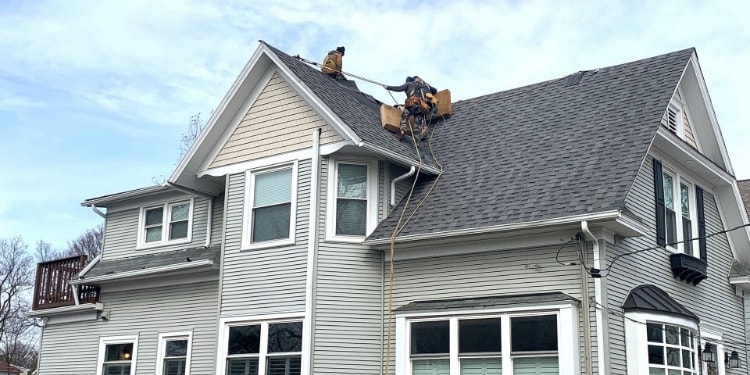
Step flashing is individual pieces of bent metal, one per shingle course, each lapped over the one below and tucked behind the siding. Done right it is a shingled system in its own right, and it does not rely on sealant to work.
The shortcut is a single continuous piece of bent metal running the length of the wall, sealed along the top with caulk. It goes in faster, it looks fine from the ground, and it fails in three to five years when the caulk shrinks and cracks. Then someone caulks it again. We have opened Ferndale dormers with four visible generations of that repair stacked on top of each other.
If your dormer has ever leaked and been "fixed" more than once, this is almost certainly why.
Where a second-story addition meets the original roof, or where a rear addition ties into the main house, you have a junction that was created by a framing crew and needs to be finished by a roofing crew.
What that requires: proper membrane under the transition, correct shingle lap direction so water runs onto rather than under, and flashing at any point where a roof plane meets a vertical wall. Done well, a tie-in is invisible and permanent. Done casually, it produces the frustrating class of leak where interior staining appears several feet from the actual entry point, because water traveled along framing before it dropped.
We trace these from the attic rather than guessing from the stain.
Ferndale houses nearly all have a chimney, and a century of Michigan freeze-thaw has opened the mortar joints on most of them.
Proper chimney flashing is two parts. Step flashing goes up the sides with the shingle courses. Counterflashing is cut into a mortar joint and folded down over the step flashing, so water running down the brick is directed out rather than behind.
The common shortcut is surface-mounting counterflashing to the brick face with sealant. On degraded hundred-year-old mortar, that seal fails quickly, and then the chimney leaks through joints that are themselves in poor condition. Sometimes the honest answer is that the brick needs tuckpointing before flashing will hold, and we will tell you that rather than install metal onto crumbling mortar and call it done.
Unused chimneys still leak. If yours is out of service, that is a conversation about capping or removal rather than a reason to ignore it.
The full-width front porch is Ferndale's signature and its roof is nearly always too low-slope for asphalt shingles. Shingles rely on gravity moving water off quickly. At low pitch, water lingers, wicks backward under the laps, and reaches the decking.
When we find shingles on a low-slope porch, we do not put more shingles on it. That section needs a rolled or membrane system, and the junction where it meets the main wall needs proper flashing and membrane. This is the correction that ends a recurring porch ceiling stain permanently instead of for another two years.
Working a Ferndale lot is a different physical job than working a suburban one, and the crew has to be set up for it.
None of this is glamorous, and all of it is the difference between a job your neighbors tolerate and one they complain about for a year.





Almost always because the sidewall has a caulked continuous strip instead of woven step flashing. Caulk is not a flashing material. It has to be rebuilt properly to stop.
Yes. Water travels along framing before it drops. Tracing it from the attic is how you find the real entry point.
We would rather not, and on most Ferndale porches we will not. The slope is too low and it will leak. A membrane system is the right answer.
Sometimes, and it can be a good solution. It removes a penetration permanently. Worth discussing with the roof work rather than separately.
Alley staging and hand-carrying, mostly. We plan it before the day rather than working it out on arrival.
Free inspection covering the roof, porch, garage, and attic, with photographs of every junction we are concerned about.
Call 734-367-4867 or request an estimate online.