
Home » Roofing » Roofer in Grosse Pointe Woods, MI
There is no exotic geometry on most houses here. No rolled eaves, no slate coursing, no catslides. What a roofer Grosse Pointe Woods MI homeowners hire is being asked for is something less glamorous and just as consequential: doing conventional work to a standard that most conventional work does not reach.
That sounds like a low bar. It is not. The things that determine whether a roof lasts twenty years or thirty-two are almost entirely invisible by the time the job is finished, which is precisely why they get skipped.
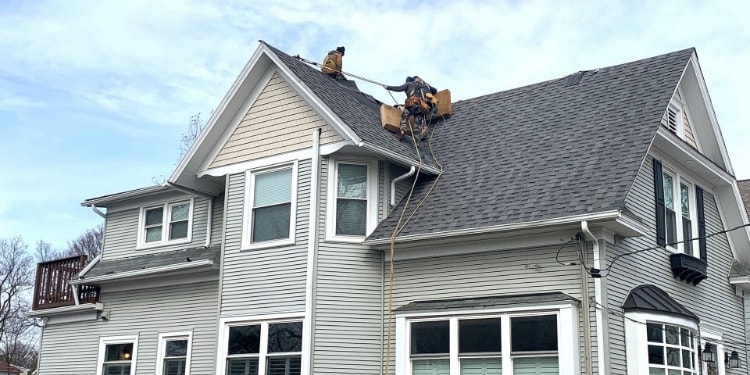
Almost every house in the Woods has been added to at least once, and the junction between the addition roof and the original roof is where these houses leak.
Those junctions were built by whoever did the addition, in whatever decade it happened, frequently by a framing crew rather than a roofing crew. What they need is continuous membrane carried under and past the seam, correct shingle lap direction so water runs onto the lower plane rather than under it, and proper flashing anywhere a roof plane meets a vertical wall.
What they often have is shingles run across the transition with a bead of sealant, which works for a few years and then does not.
The frustrating part for homeowners is that water at a tie-in travels along framing before it drops, so the ceiling stain rarely appears anywhere near the actual entry point. Tracing it from the attic is the only reliable way to find it.
This is the single most commonly omitted piece of metal on additions of this era, and it causes damage that does not look like a roof problem at all.
Where a roof plane runs down alongside a wall and ends at the gutter, a small angled piece at the bottom directs the water out into the gutter. Without it, everything running down that junction gets delivered straight behind the siding.
The result is rot inside a wall cavity while the roof above it looks perfect. Homeowners typically discover it as soft siding, peeling paint, or interior staining at a corner, and they call a siding contractor. The siding contractor replaces the damaged material, and two years later it happens again.
If you have unexplained damage at the corner where an addition or garage roof meets the house, this is very likely why.
Postwar planning here put the garage against the house, often with a low-slope connector or breezeway between them.
Two things go wrong. The junction where the garage roof meets the house wall needs the same step and kickout flashing as any addition, and frequently never got it. And the low-slope connector, if it has shingles on it, has the wrong material entirely. Below roughly a 2:12 pitch, water sits rather than sheds, and the decking underneath goes soft.
Those connectors need a membrane system rather than another layer of shingles. It is a small area and an easy thing to get right once someone actually looks at it.
On a conventional roof, installation quality lives almost entirely in details that disappear as the work progresses.
Nail placement. Nails belong in the manufacturer's designated zone, driven flush. Too high and the shingle tears free under wind load. Overdriven and the head cuts through the mat, which voids manufacturer warranties. This is the most common defect we find on failed roofs and it is entirely a workmanship issue.
Nail count. Manufacturers specify a number, and crews paid by the square have an incentive to use fewer.
Starter strip. Purpose-made starter at eaves and rakes puts the adhesive where it needs to be to bond the perimeter down. Cutting up field shingles to improvise it puts the adhesive in the wrong place.
Pipe boots. New, not reused. The rubber collar is usually the oldest failing component on the roof and it is inexpensive.
None of this is visible in a photograph of a finished roof. All of it determines how long that roof lasts.
Seventy-year-old trees over postwar lots complicate the work and the assessment both.
Limbs restrict access and staging. Valleys full of wet debris hide their own condition until they are cleared. And we flag limb contact during inspection, because a branch resting against a slope wears granules off the same spot every time the wind blows and no material solves that.





Very possibly missing kickout flashing at a roof-to-wall junction. Replacing siding without fixing that just resets the clock.
Water at an addition tie-in follows framing before it drops. Tracing it from the attic is the only reliable method.
If the pitch is below about 2:12, no. It needs a membrane system, and shingles there are why the decking is soft.
It is the most common defect on wind-failed roofs and it voids manufacturer warranties. Yes.
No. They are cheap and they are usually the oldest failing part of the roof.
Free inspection with every addition tie-in and wall junction examined individually, plus photographs of anything we are concerned about.
Call 734-367-4867 or request an estimate online.