
Home » Roofing » Roofing Contractor in Grosse Pointe Farms, MI
Standard contractor vetting covers licensing, insurance, and references. On a larger Farms property there is an additional question that rarely gets asked and probably should: can this outfit actually carry a project of this size to completion? A roofing contractor Grosse Pointe Farms MI homeowners hire for a multi-week, multi-structure job needs capacity as well as competence.
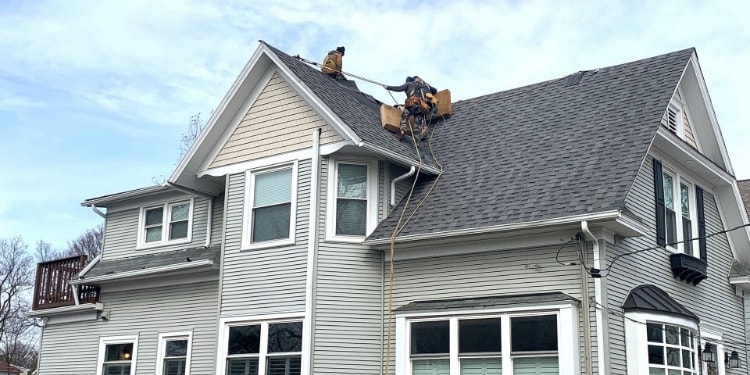
A crew that does excellent one-day tear-offs may genuinely struggle with a job that runs three weeks across four buildings. The failure mode is not bad workmanship, it is a project that stalls halfway because the company took other work, ran short of material, or underestimated the labor.
Useful questions: how many crews do you run, will the same crew be on my property throughout, what other jobs are scheduled during my window, and what happens to my roof if weather pushes everything back two weeks.
Ask for a reference on a project of comparable size and duration, not just comparable quality. Those are different capabilities.
Verify the Michigan license number in writing through the Michigan Department of Licensing and Regulatory Affairs, as you would anywhere.
Where the Farms differs is on liability limits. Standard coverage that is perfectly adequate for a suburban ranch may be genuinely insufficient here. Consider what a serious incident could involve: damage to an adjacent structure, mature specimen trees that cannot be replaced at any price, custom glazing, or hardscape that costs more per square foot than the roof does.
Ask for the actual limit, not confirmation that a policy exists, and have the certificate sent by the carrier. On the largest properties it is reasonable to ask whether the contractor can provide additional coverage for the project.
Workers' compensation matters correspondingly. Steep slate roofs at height with extended staging are among the higher-risk work in residential construction.
Some Farms properties are managed rather than owner-directed, and some owners are away for part of the year. Both change how a project needs to run.
Where a property manager or caretaker is the point of contact, the decision authority should be settled in writing before work starts. Who approves a change order when tear-off reveals bad decking, and up to what amount? Ambiguity there stalls projects.
Where the owner is not on site, photographic documentation becomes the primary reporting channel. That means organized photos by structure and elevation, sent as the work progresses rather than compiled afterward.
Phasing a large property across seasons is sensible, and it needs contract structure that supports it.
A phased arrangement should include a written assessment of the entire property up front, so each phase is planned against the whole rather than in isolation. It should define the sequence and the rationale, so the most exposed work happens first. It should state which materials are being reserved or specified now to ensure later phases match, since product lines change and dye lots vary. And it should be clear about pricing for later phases, including how long quoted figures hold.
That material-matching point deserves emphasis. If phase one goes on this year and phase three happens in three years, matching becomes a real problem unless it was planned for.
The usual advice about not paying in full up front applies, but on a multi-week project the schedule needs more structure than a deposit and a balance.
Progress payments tied to defined milestones, ideally by structure or by phase, protect both sides. You are not carrying the full exposure of a project that has barely started, and the contractor is not financing weeks of labor and material. Ask for the milestones to be written rather than assumed.





Ask how many crews they run, whether the same crew stays on your property, and for a reference on a job of similar duration rather than similar quality.
Often not. Look at the limit against what is actually at risk on your parcel, including landscaping and hardscape that may be irreplaceable.
Yes, provided authority and a change order threshold are established in writing before work begins.
Only if it is planned for. Product lines change and dye lots vary. Material matching across phases should be addressed in the original contract.
It should be addressed in the contract rather than negotiated mid-job. Ask specifically how open sections are protected during delays.
Free assessment of every structure on the property, written scope by building, and license and insurance documentation on request.
Call 734-367-4867 or request an estimate online.