
Home » Roofing » Roofer in Grosse Pointe Farms, MI
Most residential roofing is a single-day operation. Arrive, tear off, dry in, shingle, sweep, leave. Nearly everything about how a crew works is built around that rhythm. Hiring a roofer Grosse Pointe Farms MI for an estate property means hiring for a completely different rhythm, one where the crew is part of your property for weeks and every day has to end in a defensible condition.
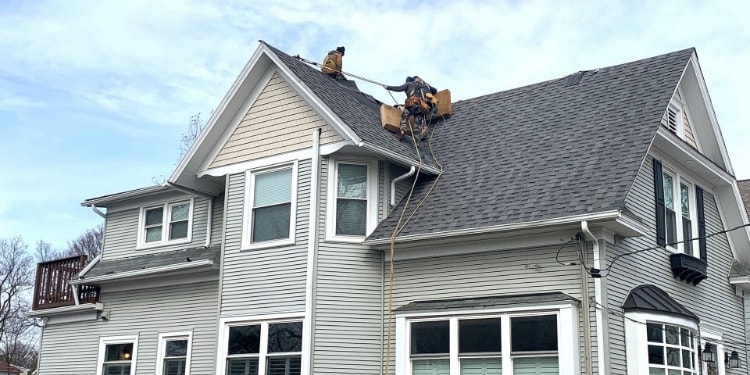
The main discipline is that a long job never gets to be "we will finish that tomorrow." Every evening the roof has to be genuinely secure, not provisionally covered.
That means dry-in progresses with tear-off rather than lagging behind it. It means open sections get properly membraned rather than tarped as a habit. It means the crew works in sequence rather than opening multiple areas to move faster, because a fast-moving crew on a fourteen-day job is a crew with several open roofs when a storm arrives.
Staging gets set once and used, rather than moved constantly. Material is staged in quantity, which requires a location that can hold it without damaging what it sits on. And the site gets cleaned daily rather than at the end, because you are living there throughout.
When a main house, a carriage house, and a pool house all get worked in the same project, they have to end up looking like they belong to each other, which is harder than it sounds.
If all structures are being done at once with the same material, the practical issue is dye lot. Material for the whole property should be ordered together rather than building by building, since batches vary subtly and the difference is visible when two structures face each other.
Where only some buildings are being done, the matching problem is against existing weathered material. New against old will not match exactly, and the honest approach is showing you what to expect and letting you decide, rather than promising a match that will not happen.
Where a secondary structure was originally built in the same material as the house, keeping it that way matters. A slate carriage house reroofed in asphalt is a permanent change to how the property reads.
Repairing a slate or tile roof means finding pieces that match what is there, and this is genuinely specialist work.
Slate varies by quarry, by color, by thickness, and by how it has weathered over a century. Some historic quarries no longer operate. Salvaged material from buildings of the same era is often the best match available and it takes time to source. Size and exposure have to match the existing coursing or the repair reads as a patch.
Clay tile has similar constraints. Profiles have changed, historic glazes are not always reproducible, and matching a hundred-year-old tile frequently means salvage.
None of this is fast. A contractor who promises same-week slate repair on a matched basis is either holding stock or not planning to match. Worth asking which.
On lakefront property, one elevation does substantially more work than the others, and it deserves being treated as its own scope within the job.
Unobstructed northeast wind off open water is a continuous condition rather than a storm event. On slate and tile it loosens fasteners and lifts individual pieces. On asphalt it breaks seal along the edges. On copper and flashing, the constant moisture accelerates everything.
We check that elevation by hand rather than visually, because on every material the failure mode is a piece that looks completely in place from the ground. Perimeter detail there gets the most attention: edge fastening, ridge treatment, and how the covering terminates at every exposed edge.
Worth being direct about what this is like, because it is a real consideration.





Dry-in keeps pace with tear-off, so open areas are membraned rather than tarped. We do not leave more open than can be properly closed the same day.
If they are all being done together, yes, and material gets ordered as one batch to avoid dye lot variation. If only some are being done, we will show you the realistic match first.
Longer than most people expect, sometimes weeks, since salvage is often the best match available. It is worth the wait on a roof that will last another fifty years.
Yes. Set hours, one staging area, and daily cleanup are how a multi-week project stays livable.
Because it fails first, and because on every material the failure looks invisible from the ground. It gets checked by hand.
Free assessment of every structure and elevation, an honest read on what can be retained, and photographs organized by building.
Call 734-367-4867 or request an estimate online.