
Home » Roofing » Roofing in Grosse Pointe, MI
In most of Southeast Michigan, specifying roofing Grosse Pointe MI homeowners would recognize as adequate means choosing a shingle and getting it installed correctly. Here there is a prior question: what did this house originally have, is any of it still viable, and what does the architecture actually want?
Getting that sequence right saves some homeowners a great deal of money and saves others from permanently removing something worth keeping.
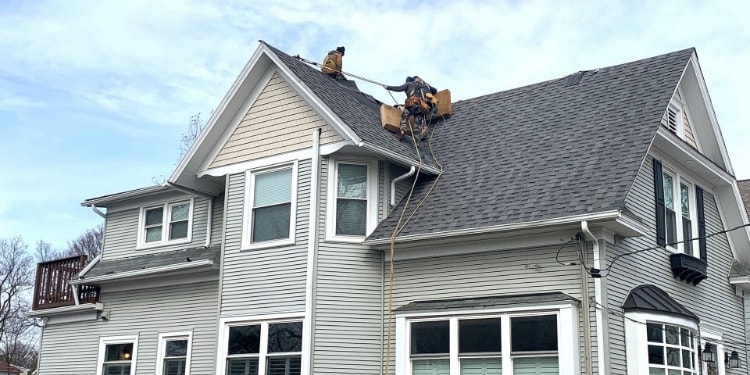
Slate on a Grosse Pointe house was frequently installed to last a century or more, and many of these roofs are not finished even when they look tired.
What actually fails is usually not the slate. It is the fasteners, the flashing, and the valley metal. Individual slates crack or slip and can be replaced. Nails corrode over decades and slates work loose. Valley and chimney metal reaches end of life long before the stone does.
Repair and restoration means resetting and replacing failed pieces, renewing flashing and valley metal, and returning the roof to service. On a slate roof with sound stone, this routinely buys decades and costs a fraction of replacement.
Genuine end of life looks like widespread delamination, slates flaking and splitting across the field rather than in isolated spots, and deck or framing that can no longer carry the weight. Then replacement is real.
Simulated slate has improved substantially. Composite and synthetic products now available reproduce thickness, edge irregularity, and tonal variation convincingly, at a fraction of slate's weight and cost. On a house whose slate is genuinely done, these are a serious option rather than a compromise.
Plenty of houses here already have asphalt, installed during some earlier conversion, and replacing it is a straightforward decision about which profile.
Designer and heavyweight architectural profiles are the right register. They carry a shadow line, they come in tonal blends rather than flat colors, and on a steep roof they read with some depth.
Standard architectural shingles work well on simpler Colonial Revival houses, on secondary structures, and where budget is the governing constraint. They are a legitimate choice, not a failure.
Three-tab is difficult to justify on any primary residence in this city.
We install as a CertainTeed Master Shingle Applicator, which determines the manufacturer warranty coverage available on your roof.
Where copper exists and is sound, keep it. Where it is being replaced or added, it is worth understanding what you are buying.
Copper valley metal will outlast several roof coverings. On a house you intend to hold, installing copper during a reroof means the next roof goes on around metal that is already there. The premium over aluminum is real but it is a one-time cost against a component that will not need attention again.
It also matters aesthetically. Copper weathers to a patina that suits these houses in a way that painted aluminum does not.
Self-adhering membrane at eaves extending past the interior wall line, in valleys, and around every penetration.
Two conditions here argue for generous coverage. Freeze-thaw cycling driven by the lake works at the eave repeatedly through the winter rather than once. And the deep overhangs on Arts and Crafts and Craftsman houses create a genuinely cold eave beneath a warm roof, which is the classic ice dam setup.
On steep Tudor rooflines with many valleys, valley membrane quantity is a meaningful line item and should appear as one.
This is the specific challenge on architecturally significant houses, and it is why ventilation on these roofs takes more thought than it does elsewhere.
Many houses here were built before attic ventilation was standard practice, so intake often does not exist. The obvious solutions are visually intrusive: box vents scattered across a visible slope, or oversized ridge treatments that change a profile the architect drew deliberately.
Better approaches exist. Ridge venting can be low-profile and concealed under a heavier ridge cap. Intake can frequently be achieved at the eave through edge venting rather than by cutting soffit vents into finished woodwork. Where a slope faces the street, vents can be located on the rear elevation instead.
The point is that it requires a plan. A contractor who proposes cutting a row of box vents across the front slope of a Colonial Revival has solved a physics problem and created a permanent aesthetic one.
On period houses the roof edge is not just a roof edge. Exposed rafter tails on Craftsman houses, cornice returns and dentil work on Colonial Revival, and decorative bargeboards on Tudors all sit exactly where roofing work happens.
Any of these that are deteriorated need addressing while the staging is up, and they need to be reproduced rather than simplified. A rafter tail cut square where it was originally shaped is a permanent change to the house that nobody will remember authorizing.





Isolated cracked or slipped pieces with sound stone elsewhere means yes. Widespread flaking and delamination across the field means probably not. Get the opinion from someone who does slate repair.
The better products genuinely are, particularly with thickness and tonal variation. Worth seeing a sample on site against your house rather than judging from a brochure.
On a house you plan to keep, usually. It outlives the roof covering, so the next reroof happens around metal that is already in place.
Not if it is planned. Low-profile ridge venting, edge intake, and rear-elevation placement can achieve the airflow without changing what you see from the street.
It should at least be addressed in the scope. Deteriorated rafter tails and cornice work sit exactly where the roof work happens and are best done while staging is up.
Free inspection, an honest assessment of what can be retained, and an itemized written quote specified to the house rather than to a template.
Call 734-367-4867 or request an estimate online.