
Home » Roofing » Roofing Contractor in Grosse Pointe, MI
Most advice about hiring a roofer assumes the houses are interchangeable. In the City of Grosse Pointe they are not, and the most useful screening question is not about price at all. It is whether the contractor can work on the kind of house you own. A roofing contractor Grosse Pointe MI homeowners should be considering has to clear the usual bar on licensing and insurance, and then clear a second one on period competence.
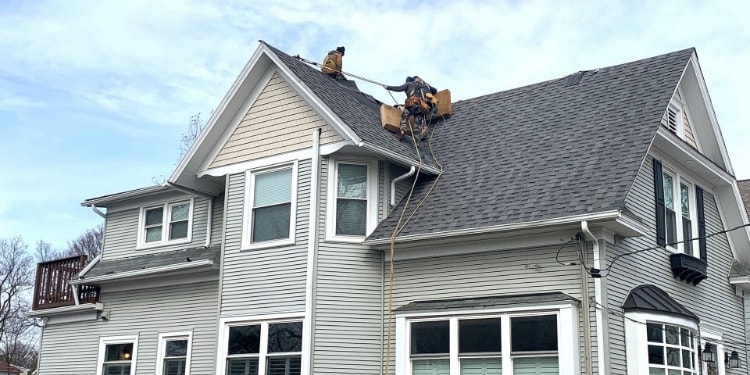
This single question sorts contractors faster than anything else in this city.
A contractor who works slate will talk about whether yours can be restored, what condition the flashing and valley metal are in, and whether individual pieces can be sourced to match. One who does not will move quickly to tear-off and replacement, sometimes without ever saying they do not do slate work.
Neither answer is disqualifying. Plenty of excellent asphalt contractors do not do slate, and that is fine if your house has asphalt. It becomes a problem when a contractor who cannot repair slate is the one advising you on whether your slate should be repaired.
If you own a slate or tile roof, get an opinion from someone with no financial stake in tearing it off.
Start with the basics. Michigan roofing work requires either a Residential Builder or a Maintenance and Alteration Contractor license, and the number should be given to you in writing rather than described. Verification runs through the Michigan Department of Licensing and Regulatory Affairs and takes a couple of minutes.
On general liability, pay attention to the coverage amount and not just its existence. Standard minimum coverage may be adequate for a suburban ranch on a large lot. On a compact Grosse Pointe lot, a dropped bundle can reach a neighbor's leaded glass, a slate walkway, or a specimen tree that took eighty years to grow. The exposure is genuinely larger, and the policy should reflect it.
Workers' compensation covers the crew. On steep Tudor rooflines requiring staging, that matters more than on a walkable roof.
Ask for both certificates directly from the carrier.
Ask for addresses in the Pointes, ideally on houses of a similar style and age to yours. A contractor with a strong record on subdivision colonials has told you very little about how they will handle a Tudor with a slate porch roof and copper valleys.
Better still, ask for work done three to five years ago rather than last month. Roofing quality on a period home reveals itself at the transitions over time, not on the day the staging comes down.
Dense blocks and narrow streets mean a roofing project here is briefly a neighborhood event. A contractor should be able to tell you where the dumpster goes, where materials stage, and how long the street will be affected.
Ask what protection is used for adjacent property. On these lots, the neighbor's landscaping and hardscape are frequently within reach of anything coming off your roof, and containment is a real practice rather than a courtesy.
Notice to immediate neighbors costs nothing and prevents nearly all the friction. We handle it. It is worth asking whoever else you are considering whether they will.
That ventilation line deserves emphasis. On a house where the roofline is a defining feature, adding ventilation is not simply a matter of cutting in whatever is cheapest. The method should be specified.
Spreads here are wide and usually reflect different jobs rather than different margins.
Check whether each quote retains or removes original material, what valley metal is specified, whether carpentry is included or excluded, and whether ventilation is addressed at all. A low bid that assumes tear-off of restorable slate is not a cheaper version of the same project. It is a different project with a permanent outcome.





On these houses, roofing frequently touches other trades, and the order matters.
Masonry before flashing. If chimney mortar needs tuckpointing, that happens first. Counterflashing cut into failing joints has nothing to anchor to.
Carpentry with the roof, not after. Rafter tails, fascia, and cornice work sit where the staging already is. Doing it later means paying to set up twice.
Gutters after the roof edge is finished. Hanging new gutters before drip edge and fascia work is settled produces a result that has to be undone.
Ventilation decisions before material is ordered. Where vents go affects what ridge treatment you need, and changing that mid-project means reordering.
A contractor who lays out this sequence unprompted has done the work before. One who treats the roof as a standalone item will hand you the coordination problem.
We have worked Southeast Michigan for more than 25 years, and period homes on the east side are a regular part of that.
Verifiable Michigan licensing, liability coverage suited to compact lots surrounded by valuable property, workers' compensation on every crew, employed rather than subcontracted labor, city permits pulled on every job, and CertainTeed Master Shingle Applicator certification determining your available warranty.
What matters most on these particular houses: we assess whether original slate and copper can stay before discussing replacement, we specify ridge and edge treatment that suits the elevation, we plan ventilation so it does not end up across your front slope, and we will tell you when the honest answer is a repair rather than a roof.
Ask what they would do with your slate, and ask for addresses of similar houses they worked three to five years ago. Both answers are revealing.
Frequently not, on a compact lot surrounded by valuable property. Look at the limit, not just the existence of a policy.
If rafter tails, fascia, or cornice work is involved, it should at least be addressed. Leaving it undefined means it gets handled badly or not at all.
A few days is plenty. On narrow streets it makes a real difference to how the week goes.
Usually because it assumes removing something the other quote intends to keep. Compare what happens to the existing roof before comparing totals.
Free inspection with an honest assessment of whether original material can be retained, written itemized scope, and license and insurance documentation on request.
Call 734-367-4867 or request an estimate online.