
Home » Roofing » Roofer in Grosse Pointe, MI
On a modern subdivision roof, a competent installation and an excellent one look identical for the first decade. On a 1928 Tudor, the difference is visible from the sidewalk on day one. Hiring a roofer Grosse Pointe MI homeowners will be satisfied with means hiring someone who works at the pace these houses require, because there is no fast version of doing them properly.
Many houses in the City were built with copper valley metal, copper flashing at chimneys, and copper gutters and downspouts. Some still have it, and where it is intact it is generally worth keeping.
Copper has a service life measured well beyond that of any roof covering around it. A copper valley installed in 1930 may be entirely sound while the shingles beside it are finished. Tearing out serviceable copper because it is easier to install new aluminum is a decision that cannot be undone, and it is one we see made regularly.
Where copper is being replaced or added, the work is fabrication rather than assembly. Valleys need proper hemmed edges and expansion allowance. Counterflashing needs to be formed to the masonry it is going into. Soldered seams need to be actually soldered rather than sealed. These are metalworking skills, not shingling skills, and not every roofing crew has them.
When a period roof is being replaced, the visual outcome depends on decisions that have nothing to do with product quality.
Exposure and course lines. Original slate on these houses often ran a different exposure than standard asphalt. Matching the visual rhythm matters on a house where the roof is a third of the elevation.
Ridge and hip treatment. A thin ridge cap on a steep Tudor looks wrong. Heavier ridge treatments cost more and read correctly.
Rake and eave edge. Where the roof meets ornamental woodwork, a drip edge installed without thought will cut across a line the architect intended. On Colonial Revival houses with cornice returns, this is where a roof job either respects the house or does not.
Color and variegation. Original slate was rarely a single flat color. Products with genuine tonal variation read far better on these houses than uniform ones.
Nearly every house here has at least one chimney, frequently more, and after a century of freeze-thaw off the lake the mortar has moved.
Correct flashing is step flashing up the sides with the courses, and counterflashing cut into a mortar joint and folded down over it. On sound masonry this is durable for decades.
The complication on hundred-year-old brick is that cutting into a degraded joint may not give you anything solid to anchor into. When the mortar is that far gone, tuckpointing has to happen before flashing, and installing metal into failing joints is work that will need doing again shortly.
We will tell you when that is the situation rather than proceeding and letting you discover it later.
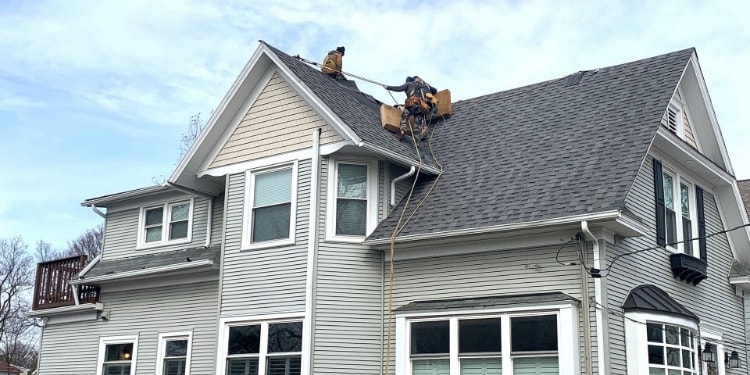
Tudor and English Revival rooflines here are steep enough that the crew works from staging rather than off the roof surface. That changes the job substantially: more setup time, a different sequence, and a real safety apparatus.
It also changes what a realistic quote looks like. A steep multi-gable roof priced at the same rate per square as a walkable ranch means somebody has not counted the hours, and the shortfall gets made up somewhere in the work.
On these lots, what is around the house frequently costs more to repair than the roof section above it.





Age and failure are different things with copper. Sound copper frequently outlasts the roof around it and is worth keeping. We assess condition rather than assuming.
With attention to profile, ridge treatment, edge detail, and tonal variation, yes. With a standard installation and a flat color, no.
Tuckpointing first. Cutting counterflashing into failed mortar gives you nothing to anchor to, and it will need doing again.
Staging, fall protection, and a slower working pace. It is real additional labor rather than a premium for the address.
That is the intent, and it is why we walk the property and agree on protection before anything comes off the roof.
Free inspection covering every plane and detail, an honest read on what can be retained, and photographs of anything we are concerned about.
Call 734-367-4867 or request an estimate online.