
Home » Roofing » Roofer in Grosse Pointe Park, MI
There is a category of roofing work that does not come up in most of Michigan and comes up constantly here. A roofer Grosse Pointe Park MI homeowners hire for a storybook Tudor is being asked to do things that are not taught on production sites and cannot be improvised on the day.
What follows is what that work actually involves, so you can tell whether the person quoting your roof has done it before.
A rolled eave curls the roof covering around a curved framing structure at the eave, imitating the way thatch rolls over a roof edge. On a Park Tudor this is frequently the single most characteristic feature of the house.
The work has three parts. First the framing beneath has to be sound, and after ninety years of water running over the most exposed edge on the building, it often is not. Rebuilding that curved substructure is carpentry, and it has to reproduce the original radius rather than approximate it.
Second, the covering has to bend. Asphalt shingles will follow a curve if they are warmed and worked, and if the radius is not too tight. Slate will not bend at all, so a curved slate eave is achieved through graduated coursing and reduced exposure, which is genuinely specialist work.
Third, the water has to still be managed. A curved eave changes how water leaves the roof, and the underlayment and edge detail have to account for that rather than assuming a straight termination.
Done properly, nobody notices it because it looks like it always did. Done as a straight eave, everyone notices, and the change is permanent.
Tudor design frequently softens the meeting of two roof planes into a curve rather than a crisp line. A swept valley widens toward the bottom, following a gentle arc.
The technical difficulty is that a valley is where water concentrates. A curved valley concentrates water while changing direction, and the membrane beneath has to be continuous through that curve without wrinkling. Shingles or slates have to be cut progressively to follow the sweep, each course slightly different from the one below.
The shortcut is a straight valley, and it is visible immediately to anyone who knows the house.
Jerkinhead and clipped gables put a small hipped plane at the top of what would otherwise be a peak. Because the plane is small, it gets treated as trivial, and because it sits at the highest and most weather-exposed point on the roof, it is anything but.
It needs proper flashing where it meets both gable slopes, and ridge treatment on a very short run. Small work, done at height, with real consequences if it is rushed.
On a gable end with decorative half-timbering and stucco, the roof edge terminates against ornamental woodwork rather than plain wall.
Flashing this correctly means working with the timber detail: metal tucked behind the appropriate element, counterflashed into the stucco where required, and sealed in a way that does not read as a metal band running across a decorative face. Running flashing over the timber is faster and it ruins the elevation.
Water getting behind this junction is also particularly damaging, because it rots the half-timbering itself, which is expensive and slow to reproduce.

A catslide plane runs well below the main eave line, sometimes nearly to the ground. It collects water from a large area and delivers it to a very small one.
The bottom of a catslide needs drainage sized for that concentration, and frequently what is there was sized for an ordinary eave. Where a catslide discharges onto a lower roof, a proper diverter keeps that flow from cutting a channel through the covering below.
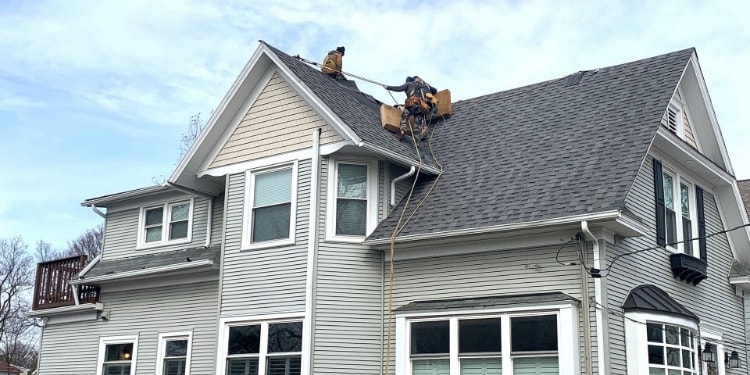
Park Tudors are steep enough that the crew works from staging throughout, and on the denser blocks that staging goes up on a lot with little clearance.





Yes, within limits. Warmed and worked they will follow a reasonable radius. A very tight curve may need a different approach, and we will tell you which yours is.
Through graduated coursing and reduced exposure, so many small increments produce the curve. It is slow and it is specialist work.
Very likely. It is the most water-exposed structure on the house and it is commonly deteriorated underneath while looking fine from the ground.
Usually water getting behind the roof-to-gable junction. Fixing the flashing detail is the actual repair; replacing timber without it just resets the clock.
Two to four on most Park Tudors, more with decorative restoration. Staging alone consumes real time before any covering comes off.
Free inspection covering every plane and decorative detail, an honest read on what can be preserved, and photographs of anything we are concerned about.
Call 734-367-4867 or request an estimate online.