
Home » Roofing » Roofing in Auburn Hills, MI
The single most consequential decision in roofing Auburn Hills MI homes is not which shingle goes on top. It is what happens in the rafter cavity beneath a vaulted ceiling, because a substantial share of houses here have large sections with no attic at all.
Get that wrong and you will have ice dams over your great room every winter regardless of what shingle you bought, and your roof will age faster than the warranty assumes. Get it right and the rest of the specification is comparatively straightforward.
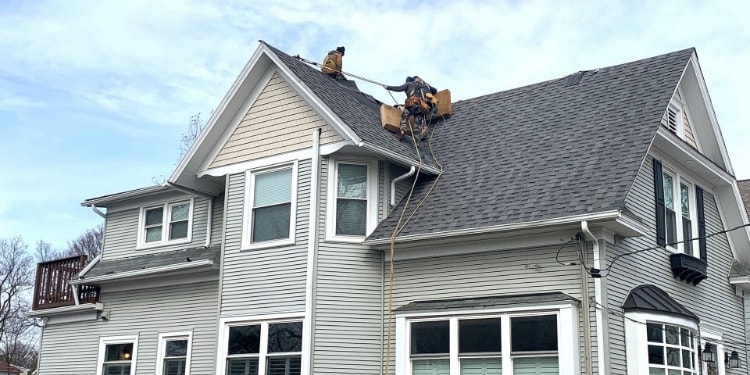
In a conventional attic, air enters at the soffit, moves through open space, and exits at the ridge. There is plenty of room, so it more or less works as long as intake and exhaust both exist.
Under a cathedral ceiling there is no open space. The rafter bay contains insulation, and the finished ceiling is fastened to the underside of the rafters. For air to move at all, a continuous channel has to be preserved between the top of the insulation and the underside of the roof deck, in every single rafter bay, running unbroken from soffit to ridge.
That channel is created with baffles. Each bay needs one, each needs intake at the bottom, and the ridge needs continuous exhaust. Miss a bay and that section has no ventilation.
The common failure is insulation stuffed to fill the cavity completely, which is often done in good faith to raise R-value. It eliminates the channel. Thermal performance improves slightly and moisture performance collapses.
A roof deck with no airflow above the insulation stays at close to indoor temperature. In winter, snow on that section melts, runs down to the eave where the roof is actually cold, and refreezes. That ridge of ice backs water up under the shingles.
Because vaulted sections sit over the most finished parts of the house, the resulting damage lands on drywall, trim, and flooring rather than on attic insulation. In summer the same deck runs substantially hotter than a ventilated one, and shingles installed over an unventilated deck reliably fall short of their rated life.
This is why a quote that itemizes ventilation for the attic and says nothing about the vaulted sections has priced only part of your roof.
The baseline. Laminated construction, solid wind ratings, and the dimensional shadow line that reads correctly on a large visible roofline. On these houses, three-tab is not a serious option.
Worth real consideration here for reasons beyond appearance. Larger roofs cost more to access and stage, so extending the interval between replacements has more value than on a small house. Many associations also prefer or require these profiles, which can settle the question.
A premium of a few dollars per square foot reads as a modest upgrade until you multiply it across a large roof. The counterweight is that the labor to reroof this house is significant regardless of material, so buying more years is buying more of the expensive part deferred.
We install as a CertainTeed Master Shingle Applicator, which determines available manufacturer warranty coverage, including systems with transferable terms that matter at resale.
Modern skylight units are substantially better than what went into houses in the 1990s. Improved glazing, better seals, factory flashing kits engineered for specific pitches, and options with integrated blinds or venting.
The practical guidance is timing rather than product. If your units are original to a house built in the 1990s or early 2000s and you are reroofing, replace them during the reroof. The roof is already open around them, the flashing kit goes in as part of the same operation, and the alternative is paying to open a new roof in a few years.
If you are not reroofing and a skylight is leaking, the diagnosis matters: a failed flashing kit is a different repair from a failed unit, and they are not interchangeable fixes.
Ice-and-water shield goes at eaves extending past the interior wall line, in every valley, around every penetration, and around every skylight.
On a roof with eight or ten valleys, that is a lot of membrane, and it should appear as a real quantity on your quote rather than a vague line. Eave coverage matters especially over vaulted sections, since those are the areas most prone to ice damming.
Synthetic underlayment across the field. On steep sections it also provides better footing during installation, which affects both safety and workmanship.
Complex rooflines concentrate water in ways simple roofs do not. Several planes may drain into a single valley that terminates at one short gutter run, and that run then handles a volume it was never sized for.
Watch for overflow at specific corners during heavy rain. That is a capacity problem, not a clog, and the answers are larger gutters, additional downspouts, or a diverter higher up. Where a valley discharges directly onto a lower roof section, a proper kickout or diverter keeps that water from cutting a channel through the shingles below.





Usually yes, from above during a reroof. Baffles can be installed from the roof side once the deck is off, which is why a replacement is the right moment to solve it.
For a vented assembly, yes. It eliminates the air channel. There are unvented assembly approaches that work, but they require specific materials and detailing rather than simply packing the cavity.
On original 1990s units, almost always. The incremental cost while the roof is open is far below the cost of doing it separately later.
Plane count, valley count, skylights, and whether vaulted ventilation work is included. Two houses of similar size can differ substantially once those are counted.
When the issue is volume from converging valleys, yes. If it overflows at one specific corner during heavy rain and nowhere else, that is capacity rather than debris.
Free inspection covering every plane, skylight, and junction, plus a real assessment of ventilation over vaulted sections.
Call 734-367-4867 or request an estimate online.