
Home » Roofing » Roofer in Auburn Hills, MI
A crew that is genuinely good on a simple gable roof can still be out of its depth on a 1990s Auburn Hills colonial. Not because the work is harder in any single spot, but because there is so much more of the difficult part. Hiring a roofer Auburn Hills MI homeowners will not be calling back means hiring for flashing competence, since flashing is most of what these roofs are.
A skylight fails in one of two places, and telling them apart determines the right fix.
The flashing kit is the metal system tying the unit into the surrounding shingles. When it fails, water enters around the skylight. Reflashing with a proper manufacturer kit solves it, and on a relatively young unit that is the correct answer.
The unit itself fails at the glazing seal or the frame. Water then enters through the skylight rather than around it, often appearing as condensation or streaking on the interior frame first. No amount of flashing work fixes this. The unit has to be replaced.
Our position on original 1990s skylights during a reroof is straightforward: replace them. Building a new roof around a twenty-five-year-old unit means cutting that roof open again within a few years, and the labor to do it later exceeds the cost of doing it now.
Installation detail matters as much as the product. The flashing kit has to be the one made for that unit and that roof pitch, stepped into the shingle courses on the sides, with proper head flashing above and a diverter where the roof above is large. Improvised skylight flashing from generic materials is a leak with a countdown on it.
A cricket is a small peaked structure built on the upslope side of a chimney, splitting water and directing it around both sides.
Without one, the upslope face of the chimney acts as a dam. Water pools, debris collects and holds moisture, and in winter you get ice sitting against masonry. It works its way through eventually, and because it enters at the chimney it tends to travel along framing before it shows inside.
Building a cricket means framing, decking, membrane, and flashing on all sides tied into both the chimney and the main roof. It is real carpentry, not a metal accessory, and it is the correct fix for a chimney that has been leaking on the upslope side for years.
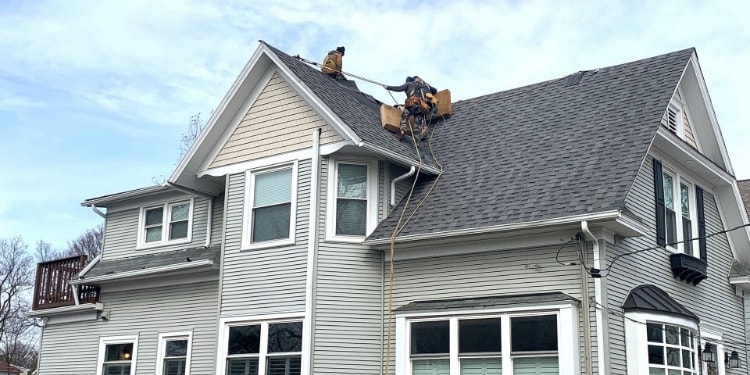
The visual signature of these houses is roof planes meeting at multiple heights and angles. Every meeting point is a valley, and valleys are where water volume concentrates.
A valley needs full membrane underneath, run continuously rather than pieced. The shingle detail above can be woven or cut-and-sealed, and either is fine done properly, but a cut valley with sloppy sealing is one of the more common failures we find on roofs of this era.
Where a valley terminates into a wall or another plane rather than running clean to the gutter, the termination detail is critical and frequently improvised. On complex roofs those terminations are where we look first.

Where an attached garage roof meets the house, or where a bonus room above the garage creates a roof-to-wall transition, you have a junction built by a production framing crew on a schedule.
These need step flashing woven into the wall covering, kickout flashing at the bottom of the run, and proper membrane behind. Kickout flashing is the piece most often missing. Without it, water running down the roof-to-wall junction gets directed straight behind the siding instead of out into the gutter, and it rots the wall from inside while the roof looks perfect.
If you have unexplained staining or soft siding at the corner where a garage roof meets the house, that is very likely the answer.
Associations notice job sites, and so do neighbors on these streets.





Both happen and they look similar. Condensation on the interior frame in cold weather often points to a failed glazing seal, which means the unit rather than the flashing. We can tell you which after looking at it.
Frequently a missing or undersized cricket. Water pools on the upslope face during volume events and finds its way through joints that stay dry in light rain.
A small piece at the bottom of a roof-to-wall junction that directs water out into the gutter instead of behind the siding. It is commonly omitted and it causes damage that looks like a siding problem.
Typically two to three days, sometimes more with skylight replacement or significant decking work. Anyone promising a single day on a twelve-plane roof has not counted the flashing.
Yes. Tell us what they are, or we will ask. Work hours, dumpster placement, and approved materials are all normal constraints.
Free inspection with every plane, valley, skylight, and junction assessed individually, plus photographs organized by area.
Call 734-367-4867 or request an estimate online.