
Home » Roofing » Roofer in Flat Rock, MI
Shingle packaging carries a wind rating, and homeowners reasonably assume that number describes the shingle. It does not. It describes the shingle installed exactly as the manufacturer specifies, and the gap between that and how roofs actually get installed is where most wind failures live.
Hiring a roofer Flat Rock MI homeowners can trust on an open lot means hiring for installation discipline, because on an exposed site the installation is doing more work than the material is.
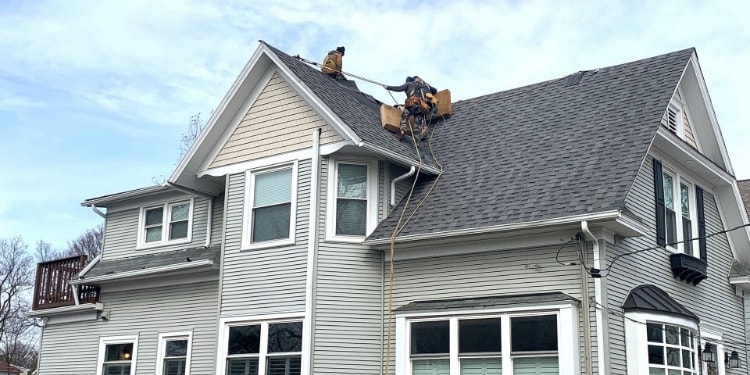
Nail placement is the single largest determinant of whether a roof survives wind, and it is invisible the moment the next course goes down.
Nails belong in the manufacturer's designated nailing zone, a narrow band that on laminated shingles catches both layers. Placed too high, the nail catches only the top lamination and the shingle tears free under load. Driven too deep, the head cuts through the mat and the shingle is effectively unattached. Driven too shallow, the head holds the course above it off the deck.
Manufacturers also specify a nail count, typically higher for high-wind applications. Crews paid by the square have an incentive to use fewer. On a Flat Rock lot with no windbreak, that shortcut is the whole ballgame.
Wind does not lift a shingle in the middle of a roof field. It gets under an edge and works inward, which makes perimeter detail disproportionately important on exposed sites.
Starter strip along both the eaves and the rakes provides the adhesive bond that seals the first course down. Skipping rake starter, or improvising it from cut-up field shingles with the adhesive in the wrong place, is common and it is exactly where wind damage begins.
Drip edge at eaves and rakes gives the shingle a defined edge to seal against and keeps water from wicking back onto the fascia.
Ridge caps take the most direct wind loading on the roof. They need proper fastening and, on exposed sites, they are worth specifying in a heavier profile.
A lot of Flat Rock housing dates from the 1990s and 2000s, and those roofs come with their own pattern.
The decking is generally sound, which makes tear-offs cleaner and faster than on older housing stock. What we do find is builder-grade three-tab or entry-level architectural shingles reaching end of life, ventilation that was specified to code minimum rather than to what the attic actually needs, and pipe boots whose rubber collars have cracked. Boots are cheap and they are the most common leak source on a roof that is otherwise fine.
Complex rooflines are also more common in this era of building. More gables, more dormers, more valleys. Every one of those is a transition, and transitions are where skill separates crews.
Larger lots mean garages, pole barns, and workshops, and these get neglected because nobody is in them daily. By the time a leak is noticed, water has usually been working on the decking or the framing for a while.
We treat them as real roofs. Same underlayment standards, same flashing detail, same cleanup. They are usually simple geometry and quick work, which is precisely why there is no excuse for doing them casually.
Our crews work for us. That is not a marketing line, it is the reason the installation standards above are consistent from one job to the next. A company that subcontracts cannot enforce nailing discipline it does not supervise.





Only by hand, on the roof. A lifted-and-resettled shingle looks identical to an intact one from the ground. This is the main reason ground-level inspections miss wind damage.
It is the most common defect we find on wind-failed roofs, and it voids manufacturer warranties. Yes.
No. They are inexpensive and the rubber is usually the oldest failing component on the roof. Reusing them on a new roof is a false economy.
It depends on the shingle and the exposure, and the manufacturer specifies it. On exposed Flat Rock lots we install to the high-wind specification rather than the minimum.
Yes, and we allow for the extra ground. Magnetic sweep across the full work area, not just the drip line.
Free inspection with hands-on seal testing, attic assessment, photographs, and a written quote.
Call 734-367-4867 or request an estimate online.