
Blown-in cellulose for attics and walls, plus removal of old, damaged insulation, installed by a local Livonia crew.
The Modern Pros is the insulation contractor Bloomfield Hills homeowners call when a large, carefully built house still has a bedroom wing that never warms up or a great room that bakes all afternoon. Big homes on wooded lots do not lose heat in one place. They lose it through a dozen small paths spread across several attics, bump-outs, and old exterior walls, and finding those paths is where good work begins.
Bloomfield Hills grew from farmland into a retreat for Detroit families in the early twentieth century, and it still carries that character: winding private drives, mature tree canopy, and homes that range from period estates to mid-century modern designs to recent custom builds. Each of those eras hides its heat loss differently. As an insulation contractor Bloomfield Hills, MI owners invite into some of the area's most distinctive homes, we focus our insulation services on three things we do very well: blown-in cellulose in attics, dense-pack cellulose in closed exterior walls, and clean removal of old, failing insulation.
A typical ranch has one attic and one set of exterior walls. A Bloomfield Hills estate might have a main attic, two or three smaller attics over wings and garages, attic pockets behind the knee walls of finished third-floor rooms, and exterior walls built decades apart. Each of those spaces behaves like its own small climate. Any insulation contractor Bloomfield Hills homeowners bring in should treat them that way, because a single furnace or air handler is asked to keep them all comfortable.
When one zone is under-insulated or leaky, owners often add equipment rather than fix the shell. More tonnage or another zone damper can mask the problem for a while, but it raises operating costs and rarely fixes the cold primary suite. As an insulation contractor Bloomfield Hills families rely on, we start with the attic floor and the walls, because steady comfort comes from the building envelope first and the mechanical system second.
Our assessments in larger homes take longer than a quick look through the hatch, and that is intentional. We walk every accessible attic, measure existing depths, identify what is already up there, and look for staining, compression, or signs of animal activity. In cold weather, a thermal camera shows where warm air is escaping at top plates, recessed lights, chimney chases, and wall cavities that were never filled.
Many Bloomfield Hills homes have been remodeled more than once. A kitchen expansion from one decade may sit beside a sunroom wing from another, and the attic above each can vary from generous to nearly bare. Mapping those differences lets us recommend work in a sensible order instead of treating the house as one uniform box. The result is a written plan that ranks each attic and wall section by how much comfort it can return. Few owners expect that level of detail, but it is the only way an insulation contractor Bloomfield Hills homes deserve can get a large house right.

We install one material, and we install it well. Cellulose is made largely from recycled paper fiber, treated with borates for fire resistance and to discourage mold and pests. It can be blown loose across an attic floor or packed tightly into a closed wall, which makes it a natural fit for houses with as much variety as these. Every insulation installation is handled by our own crews, start to finish. That focus is what separates a specialized insulation company in Bloomfield Hills from an installer who brings a different product to every room.
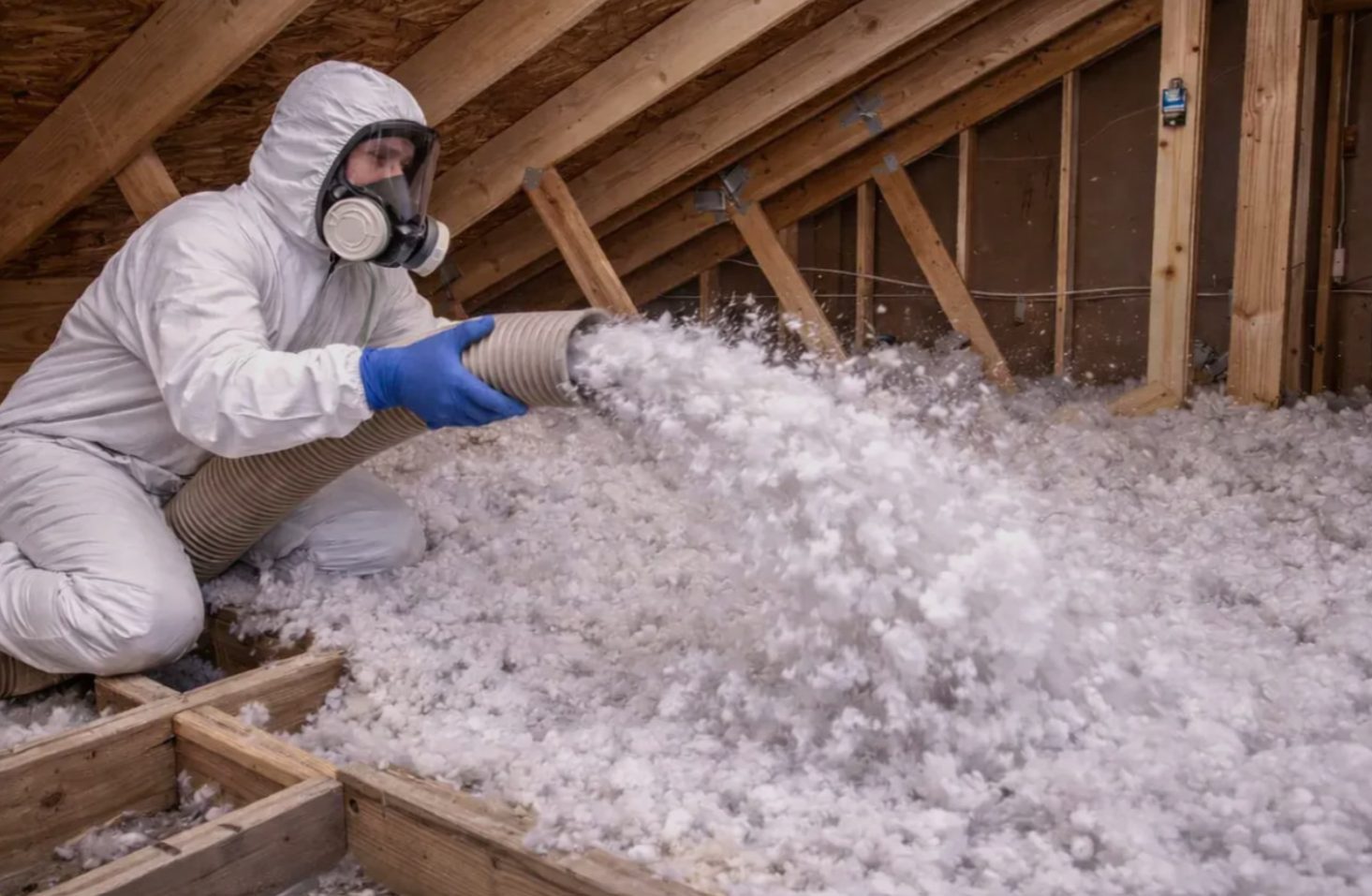
Blown loose, cellulose flows around wiring, blocking, truss webs, and odd framing with very few gaps. In the wide main attics over many Bloomfield Hills colonials and Tudors, and in the chopped-up attics under hip roofs and dormers, it reaches the recommended depth without disturbing the finished rooms below. Because loose-fill settles a little after installation, we blow to a measured installed depth and set depth rulers so you can see the result. For most owners, cellulose is the most practical form of blown-in insulation for a big, irregular attic.
Some of the area's older homes have exterior walls with little or no insulation. Dense-pack cellulose lets us fill those cavities from small drilled holes, which are then plugged and patched. The material goes in at a much higher density than attic loose-fill, tight enough that it will not slump and leave a cold band at the top of the wall. On houses with brick, stone, or stucco exteriors, we can often work from inside closets or less visible wall sections, protecting the facade that gives these homes their character.
Attics in mature, heavily wooded neighborhoods sometimes host squirrels, mice, or raccoons. When old fiberglass batts or loose-fill have been nested in, soiled, or soaked by a past roof leak, we vacuum the old material out, sanitize the space, seal entry points, and replace it with fresh cellulose. More on that below.
Have a wing that never feels right? Let us map the heat loss and give you a room-by-room plan for your Bloomfield Hills home.
Call (734) 367-4867Request a Free EstimateNot every attic needs to be cleared. When the existing layer is dry, clean, and simply too thin, we air seal and blow cellulose right over it, which is the most economical path to the target depth. When the existing material is contaminated, wet, or so compressed it no longer does its job, adding more on top just buries the problem. Knowing which case you have is one of the most important calls an insulation contractor Bloomfield Hills homeowners hire will make.
We recommend full removal when we find:
We run a large hose from a truck-mounted commercial vacuum through a protected path, usually a garage door or a window, so nothing is carried through your finished rooms. The old material is pulled into sealed bags for disposal. With the attic floor finally visible, we sanitize affected areas, seal the top plates and penetrations that were hidden, close up animal entry points, and then blow in fresh cellulose to the planned depth. Clearing out old insulation also gives an insulation contractor Bloomfield Hills homeowners hire the clearest possible look at wiring and framing.
Older attics may also contain vermiculite, a pebbly, gray-brown loose fill. It should be tested before anyone disturbs it. If testing shows a problem, our asbestos removal team can handle abatement before new cellulose goes in.

The spaces below account for most of the comfort complaints we hear from Bloomfield Hills owners. Each one calls for a slightly different approach, and an insulation contractor Bloomfield Hills families can rely on should be comfortable working in all of them.
Attic insulation Bloomfield Hills homes need often involves more than one attic. Your insulation contractor Bloomfield Hills team should measure each attic on its own rather than assuming one depth for the whole house. We bring each space to the recommended depth, install baffles at the eaves, and build insulated, weatherstripped covers for every hatch and pull-down stair.
Guest suites and playrooms above large garages are among the most common cold spots we see. The attic space above and beside those rooms is often shallow and poorly sealed. We air seal that attic floor and blow cellulose to full depth, which is often the fix that earns the quickest thank-you from whoever sleeps in that room.
Finished upper floors under a steep roof are walled in by short knee walls with attic space behind them. Where that space is accessible, we seal the floor where it meets the room below and blow cellulose across it so the room stops pulling cold air from the eaves. It is one of the jobs an insulation contractor Bloomfield Hills owners call most often for third-floor guest rooms.
Dense-packed walls make the biggest difference in the oldest sections of a house, where a thermal scan shows cavities that were never filled. We can stage wall work one wing at a time, and an insulation contractor Bloomfield Hills families trust with period homes will always test a few cavities first to confirm what is inside.
Southeast Michigan sits in IECC climate zone 5. The ENERGY STAR R-value recommendations for zones 5 and 6 are the targets we use when planning work in Bloomfield Hills, MI.
| Area of the Home | ENERGY STAR Recommendation (Zones 5–6) | What It Means for an Estate Home |
|---|---|---|
| Uninsulated attic | R60 | Common over older wings or additions that were never fully insulated |
| Attic with 3–4 in. of existing insulation | Add R49 | Typical of main attics that have not been updated in decades |
| Empty exterior wall cavities | Fill the cavities (we dense-pack with cellulose) | Most valuable in period wings with plaster or masonry walls |
Hitting these numbers matters, but so does consistency. An attic at R60 beside a garage attic with a thin, matted layer will still feel uneven. Our goal is to bring every attic and wall section up together. As the insulation contractor Bloomfield Hills homeowners hire for whole-house work, we track every space against these targets in your written plan. Attic insulation Bloomfield Hills homes received decades ago rarely meets today's numbers, so most projects start there.
Bloomfield Hills rooflines are rarely simple. Valleys, dormers, turrets, and intersecting gables create places where snow piles up and warm air escapes. When heat leaks into the attic, it melts snow on the upper roof; the water then refreezes at the colder eaves and forms ice dams that can push water under shingles, slate, or tile.
Insulation alone does not stop that cycle. Air sealing does the heavy lifting, which is why every insulation contractor Bloomfield Hills roofers respect starts with a sealing plan. Before any cellulose goes in, we seal:
Then we install baffles so intake air can travel from the soffits to the ridge without being blocked by new cellulose. Good attic insulation Bloomfield Hills roofs can rely on keeps the deck cold and even, while the baffles keep fresh air moving above it. If your roof is due for work, our team also handles roof replacement in Bloomfield Hills, which lets us coordinate ventilation and insulation in one plan. Clear, well-sized gutters and downspouts help too, especially under heavy tree cover.
Owners of large homes often get used to quirks that are really symptoms. If any of these sound familiar, it may be time to call an insulation contractor Bloomfield Hills neighbors have used:
Homes here are full of finishes worth protecting, from hardwood floors to custom millwork. Our process is built around that, and it is the same careful sequence our insulation contractor Bloomfield Hills crews follow on every job, whatever the size.
Many owners schedule work while traveling or during quieter weeks. As an insulation company in Bloomfield Hills households can hand a key to, we take that trust seriously. We coordinate access with house managers or family members and keep you updated throughout.
Depending on your utility and current program rules, rebates may be available for insulation and air sealing. Many Bloomfield Hills homes are served by DTE Energy and Consumers Energy; you can review their offerings on the DTE insulation rebates page and the Consumers Energy windows and insulation rebates page. Your insulation contractor Bloomfield Hills team should document depths and materials, and we provide that information as part of every job.
ENERGY STAR estimates that homeowners can save an average of about 15% on heating and cooling costs by air sealing and adding insulation. In a larger home with several zones, that improvement often shows up first as better comfort in the rooms that used to lag. Bloomfield Hills insulation upgrades often pay back in comfort before they show up on a bill. Financing is available, and you can check our current discounts before you book.
As an insulation contractor Bloomfield Hills residents see on streets across the city, our crews work everywhere from the streets around the Cranbrook campus and Christ Church Cranbrook to the homes along Lone Pine Road, Long Lake Road, and the Woodward corridor. Cranbrook's historic houses and Frank Lloyd Wright's Usonian Smith House are reminders that many homes here were built with architectural intent. Because dense-pack walls and blown attics work from small holes and existing hatches, a modern home insulation upgrade can make these houses far more comfortable without changing what makes them special.
We also serve the surrounding communities. If you live just outside city limits, see our pages for an insulation contractor in Bloomfield Township, an insulation contractor in Birmingham, or an insulation contractor in West Bloomfield. City services, permits, and local ordinances are listed on the City of Bloomfield Hills official website.
The city's mature trees are a big part of its appeal, and the city regulates tree removal on residential property. Shade helps in summer, but heavy canopy also means leaf-filled gutters, damp roof edges, and easy roof access for squirrels. That is one more reason we look at the roof edge, gutters, and attic together.
We are a full-service exterior and home improvement company based in Livonia, licensed and insured, and we handle roofing, siding, gutters, insulation, painting, and asbestos removal under one roof. That matters for an insulation company in Bloomfield Hills because envelope problems rarely stay in one trade. When you hire us as your insulation contractor Bloomfield Hills project lead, one team sees the roof, the attic, the walls, and the gutters together.
Learn more about our team, or reach out and we will schedule a walkthrough at a time that suits your household.
Look for an insulation company in Bloomfield Hills that inspects every attic, explains air sealing as well as insulation, and gives you a written plan by area. Ask how they protect finished spaces and whether they can coordinate with roofing or siding work. That is the standard we hold ourselves to as an insulation contractor Bloomfield Hills families invite back for future projects.
Often, yes. Dense-pack cellulose can be installed from inside through small holes that we plug and patch, usually in closets or less visible wall sections. We test a few cavities first to confirm they are open and dry before recommending it.
Not always. We measure each one separately. It is common to find a main attic in decent shape and a garage or wing attic that is badly under-insulated or full of soiled material. Your plan will show which spaces need attention and which can wait.
Usually, yes, for outside noise. Dense-packed exterior walls and a deep attic layer absorb a good share of traffic and yard-equipment sound. Sealing gaps around outlets and fixtures helps too, since sound travels through the same openings as air.
A single attic top-up is often a one-day project. Homes that need old insulation removed, several attics, or dense-packed walls may take two or three days. We give you a schedule up front and keep work areas organized each evening, so blown-in insulation work never leaves the house in disarray overnight.
Yes. Ice dams start when heat escapes into the attic. Air sealing, proper depth, and balanced ventilation keep the roof deck colder and more even, which reduces melting and refreezing at the eaves. That protects any roofing material, including slate and tile.
Ready for a home that feels the same in every room? Talk with the insulation contractor Bloomfield Hills homeowners turn to for careful, whole-house work, and schedule your walkthrough with our insulation contractor Bloomfield Hills team today.
Call (734) 367-4867Request a Free Estimate