
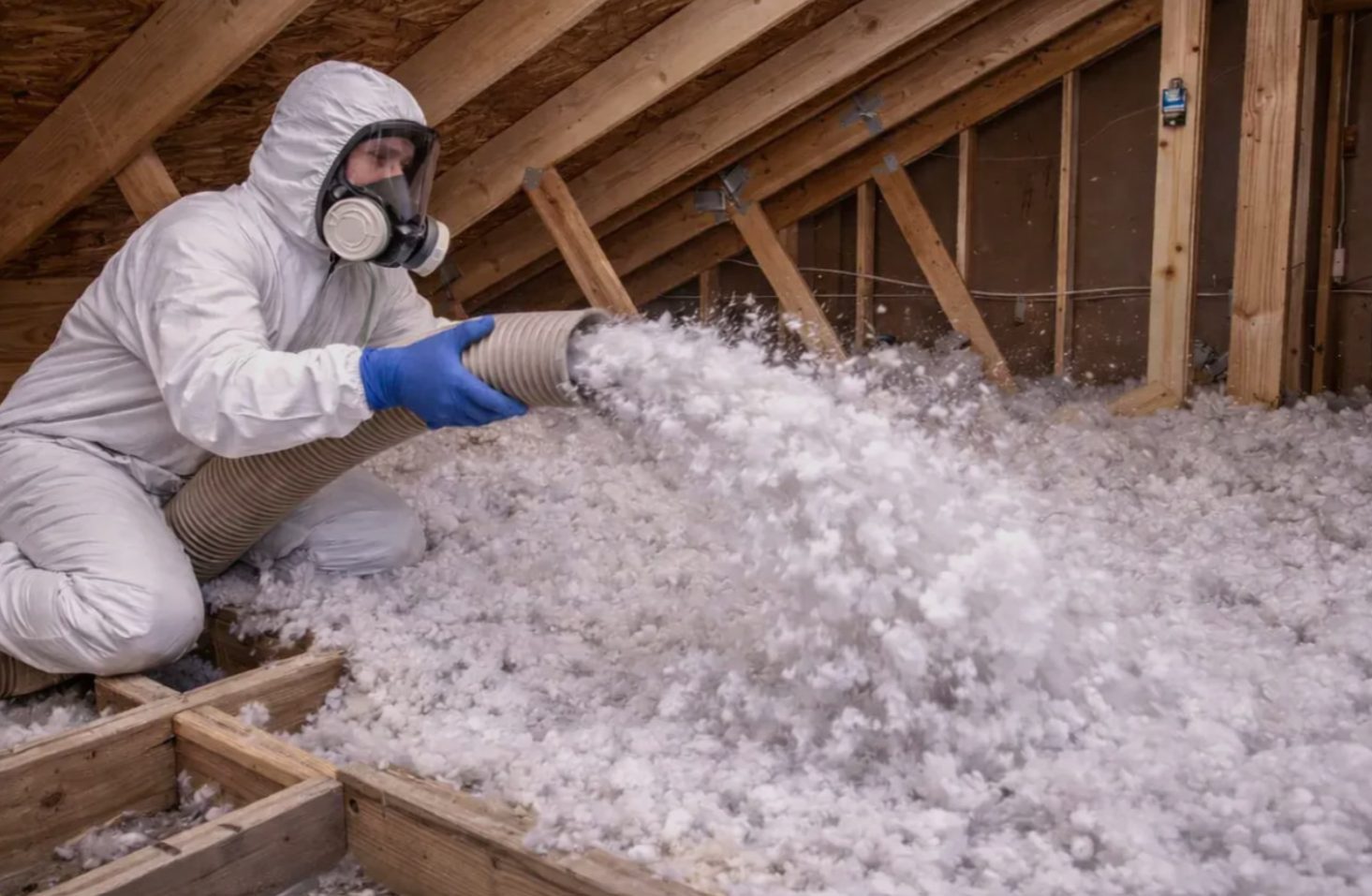
Blown-in cellulose for attics and walls, plus removal of old, damaged insulation, installed by a local Livonia crew.
Quaker settlers founded this town in 1824, and two centuries later its streets still hold an unusual mix: Greek Revival and Victorian houses near the old village center, and block after block of tidy postwar ranches spreading out from Grand River Avenue. As the insulation contractor Farmington homeowners call for both kinds of house, The Modern Pros know that a 19th-century home near the Governor Warner Mansion and a 1950s brick ranch need very different plans, even though both get cold in January.
We're a licensed and insured home-improvement contractor headquartered just down the road in Livonia, and serving as an insulation contractor Farmington, MI families know is part of our regular work. Our crews handle roofing, siding, gutters and insulation, and we spend a lot of time in this compact, walkable city. This page explains how an insulation contractor Farmington residents trust approaches local homes, why we install only blown-in cellulose, when old insulation should come out, how the process works, and how to plan an upgrade that actually makes your home more comfortable.

Farmington's housing falls into two broad groups, and almost every call we take fits one or the other. Knowing which group your house belongs to is the first step in deciding what Farmington insulation work makes sense, and it's the first question an insulation contractor Farmington homeowners call should ask.
Part of downtown is listed on the National Register as the Farmington Historic District, a roughly triangular area along Grand River Avenue and Shiawassee Street. Its buildings span from the 1820s through the late 1800s, with modest Greek Revival houses, former farmhouses and later Victorian homes. Victorian-era houses also appear elsewhere along Grand River. These homes have high ceilings, tall windows, original plaster and attics that were never meant to be part of the thermal envelope. They reward an insulation contractor Farmington owners can trust to work slowly and carefully.
Farmington stayed small until after World War II, then grew quickly. Many of today's homes were built in the 1940s and 1950s, and one-story ranches dominate those neighborhoods, along with some Tudor-inspired designs. These houses are simpler for an insulation contractor Farmington ranch owners hire to insulate, but they have their own patterns: shallow attics, original thin layers that have settled, empty 2x4 walls behind brick or siding and, in many attics, decades of dust and rodent traffic.
Whichever group your house falls into, an insulation contractor Farmington residents hire should explain the plan in terms of your specific home, not a generic package.
Houses from the 1800s were built with solid lumber, plaster on wood lath and generous trim. They were also built to breathe, heated by stoves and fireplaces that tolerated drafts. Adding insulation to one of these homes is rewarding, but it must be done carefully so moisture doesn't get trapped where it once dried out freely. That is the core skill an insulation contractor Farmington historic-home owners hire should bring.
Most historic walls are hollow. Dense-pack cellulose installed through small drilled holes fills each bay firmly and cuts air leakage dramatically. Holes are plugged and patched afterward. On homes with original exterior siding, we can drill from the inside when that better preserves the facade, and we evaluate each wall for moisture sources before filling.
Some Victorian-era houses were balloon-framed, meaning wall studs run continuously from the foundation to the roof. That creates open channels where air can travel from low in the house straight up into the attic. Our insulation contractor Farmington crews seal the open tops of those cavities from the attic with fire-rated material, and dense-packing the wall then plugs the channel along its length, which stops the chimney effect.
Knob-and-tube wiring may still exist in some older homes; insulation should not be installed in contact with live circuits, so we identify it and coordinate with an electrician when needed. Vermiculite in an old attic should be tested for asbestos before disturbance. Our team also performs asbestos removal, which keeps the project moving.
Once walls and wiring are addressed, attic insulation Farmington's older homes need begins with sealing every penetration in the ceiling plane, then building up depth with blown-in cellulose and baffles at the eaves. Tall Victorian roofs usually leave plenty of headroom to reach R60.
For mid-century ranches, the work is usually faster and more predictable. Here's what a typical plan from an insulation company in Farmington looks like for a 1950s brick ranch:
Most of that can be completed in a day or two, and the results show up on the next gas bill. Attic insulation Farmington ranches receive is usually the single largest improvement on that list. It's also the kind of job where an insulation contractor Farmington ranch owners trust can show measurable before-and-after differences with a thermal camera.
Older Farmington houses rarely look the way they did on the day they were finished. Generations of owners enclosed porches, added rear kitchens, finished upstairs rooms and tucked bathrooms under stairways. Each change created a new edge where heated space meets cold space, and those edges are where an insulation contractor Farmington homeowners hire usually finds the worst drafts.
A porch that was closed in decades ago often has uninsulated walls and a small attic space under its roof. Where the walls are closed, we dense-pack them with cellulose. Where there is a reachable attic above, even a low one, we seal it and blow cellulose across it so the room stops feeling like the outdoors in February.
Additions built in different decades meet the original house at awkward junctions. The connection between old and new framing, especially where two rooflines meet, is a common leak point. We seal those transitions from the attic side, then blow cellulose into the addition's attic pockets and dense-pack its closed walls to match the rest of the plan.
Some older two-story homes and story-and-a-half houses have bedrooms tucked under the roof with sloped ceilings and knee walls. Those rooms overheat in summer and chill in winter. Clearing out old, slumped batts from behind the knee walls, plugging the open joist bays beneath them with dense-packed cellulose, blowing loose cellulose over the knee-wall attic floors and filling the attic above the flat ceiling brings them back into balance. For owners of these homes, this is often the most noticeable piece of Farmington insulation work we do.
Later ranches often have an attached garage whose attic connects to the main attic. When that space is open to the house attic, it gets the same treatment: air sealing, baffles and a full depth of cellulose. It's a small, inexpensive piece of Farmington insulation work with a noticeable payoff.
The Rouge River flows through Shiawassee Park, and the town's mature trees, old roofs and two-century-old siding all affect how water moves around a house. Before an insulation contractor Farmington homeowners hire fills a closed wall, it pays to know that wall stays dry.

If water is actively getting in, that needs to be solved first, and any honest insulation company in Farmington will tell you so. Well-maintained gutters and downspouts are often part of the answer, since they carry roof water away from the house.
The Modern Pros install one material, blown-in cellulose, in two forms: loose-fill for attics and dense-pack for closed walls. Here's why an insulation contractor Farmington homeowners rely on builds every plan around it.
Cellulose is made mostly from recycled paper, broken down into fine fibers and treated with borates. That treatment gives it fire resistance and helps it resist mold, insects and rodents. For homeowners who like the idea of reusing material in a two-century-old town, the recycled content is a nice bonus.
How we reach the cavity depends on the house. In historic plaster walls near Grand River, we usually drill from inside, fill and plug, and the patch is ready for paint. In mid-century ranches with drywall, the process is the same but quicker. On wood clapboard or later siding, we can sometimes remove a board, drill behind it and replace it. Each bay is packed tight enough that the cellulose cannot settle and leave a void.
Attics in 19th-century homes have irregular joists, old wiring paths and plaster keys between the lath. Loose cellulose flows around all of it. We blow to a measured depth that allows for the slight settling cellulose does in its first months, so the finished layer still meets the target.
Packed cellulose resists air movement, not just heat. That matters in drafty old houses, where the feeling of cold often comes from air leaking through wall cavities rather than from the wall surface itself.
Old house or mid-century ranch, we have a plan for it. Talk with the insulation contractor Farmington homeowners recommend.
Call (734) 367-4867Request a Free EstimateGood Farmington insulation isn't only about January. The same attic layer that holds heat in during winter keeps August sun from baking upstairs bedrooms in older two-story homes. Air sealing also cuts the pollen and dust that drift in through gaps around trim and attic hatches, which many homeowners notice within weeks.
Sound is the other benefit. Houses along Grand River Avenue, Farmington Road and Nine Mile see steady traffic, and dense-packed cellulose in the street-facing walls makes a noticeably quieter home. When we plan attic insulation Farmington homeowners request, we'll ask whether noise is a concern so we can include it in the scope. If so, the insulation contractor Farmington residents call can add sound control without a separate project.
Farmington is in IECC climate zone 5, and every insulation contractor Farmington homeowners consider should plan around it. The ENERGY STAR R-value chart gives these targets for Michigan homes:
| Area | ENERGY STAR Guidance | Farmington Example |
|---|---|---|
| Uninsulated attic | R60 | Some 19th-century homes near the historic district |
| Attic with 3–4 in. existing | Add R49 | Most 1940s–1950s ranches |
| Empty exterior wall cavities | Fill empty cavities | Dense-pack cellulose in plaster walls and hollow ranch walls |
ENERGY STAR estimates that homeowners can save an average of about 15% on heating and cooling costs by air sealing and adding insulation. In a drafty 19th-century house, the comfort gain can feel even larger; in a ranch, the improvement is often visible on the very next utility bill. Ask any insulation contractor Farmington homeowners interview to show you the R-value they'll reach in each part of your house.
When warm air escapes into the attic, it heats the roof deck, melts snow and lets the water refreeze at the cold eaves. That's an ice dam, and it can force water under shingles and into ceilings. Air sealing is the cure, with ventilation and insulation playing supporting roles. Our insulation contractor Farmington crews seal before they insulate on every job:
Because we also handle roof replacement and repair, we can tell whether your attic ventilation suits your roof and coordinate both projects if your shingles are nearing the end of their life.
Adding a fresh layer on top of a failed one rarely works well. In decades-old attics, we regularly find material that has been flattened by stored boxes, soaked by past roof leaks, or nested in by mice and squirrels drawn by the mature trees around town. Contaminated material holds odors and moisture and no longer slows heat the way it should.
When removal is warranted, our crew uses a high-powered vacuum system to pull the old material out through a hose to a collection bag outside, so it never travels through your living space. We then clean the attic floor, seal penetrations and blow in fresh cellulose. Removal and replacement is a regular part of attic insulation Farmington's oldest homes require, and it's always included as a separate line in your estimate so you can see what it costs.
When a ranch is getting new siding, it's the perfect time to dense-pack empty wall cavities with cellulose from the outside before the new siding goes up, the approach ENERGY STAR recommends for re-siding projects. The Modern Pros install Mastic by Ply Gem siding, so we can coordinate the siding and insulation scope as one job.
Historic homes are different. Owners near the historic district usually want to keep original exteriors intact, so we work from the inside wherever possible. If your project involves visible exterior changes, check with the city first; an insulation company in Farmington that works on older homes should always recommend that step.
Any of these is reason enough to schedule an inspection. Several together usually point to a whole-house plan that tackles air sealing, the attic and the walls in one visit, which saves setup time and lets you feel the full benefit right away.
Rebates may be available depending on your utility and current program rules. Review the DTE Energy insulation rebates and Consumers Energy insulation and window rebates. Program rules change, so confirm eligibility before work begins; we'll supply the documentation you need. Financing is available, and you can browse our discounts. As an insulation company in Farmington that also handles roofing and siding, we can help you sequence projects so the budget goes further.
We serve homes throughout the city: the historic blocks near Grand River Avenue and Farmington Road, the streets around Riley Park and the Farmington Civic Theater, neighborhoods near Shiawassee Park, Drake Park and Flanders Park, and the residential areas around Farmington High School and Longacre Elementary. Whether you live a block from the Saturday farmers market or on a quiet ranch street farther out, the insulation contractor Farmington neighbors recommend is close by.
We also work in surrounding communities. See our pages for an insulation contractor in Farmington Hills, an insulation contractor in Livonia and an insulation contractor in Novi. For permits and city services, visit the City of Farmington website.
Farmington homeowners value the character of their town, from the restored storefronts downtown to well-kept ranch streets. They want a contractor who respects that. Here's what sets us apart:
Read more about The Modern Pros and our full insulation services.
Yes, when done carefully. We check for moisture sources, address balloon-frame openings and old wiring, and use dense-pack cellulose that fills the cavity firmly. We also look at the condition of exterior paint and siding, since a sound exterior keeps rain out of the newly filled wall.
Usually not. Most work happens from inside or the attic. Where exterior drilling is better, holes are plugged and patched, and we discuss the approach with you before drilling anywhere visible from the street.
Most ranch attics, including air sealing and baffles, take one day. Removing old material or adding wall dense-packing may add a second day.
Specializing lets our crews master one material in the two places it performs best: attics and closed walls. Cellulose fills irregular old cavities, resists air flow and is borate-treated. We'll still remove other old materials when they have failed.
Yes, combined with air sealing and ventilation. When house heat stays below the ceiling, the shingles stay near outdoor temperature and snow sits on the roof until it melts naturally.
When the existing material is wet, moldy or rodent-damaged, yes. Clean, dry material in good shape can usually stay, with new cellulose added on top after air sealing.
Two centuries of homes, one trusted team. Call the insulation contractor Farmington families rely on for a free estimate.
Call (734) 367-4867Request a Free Estimate